
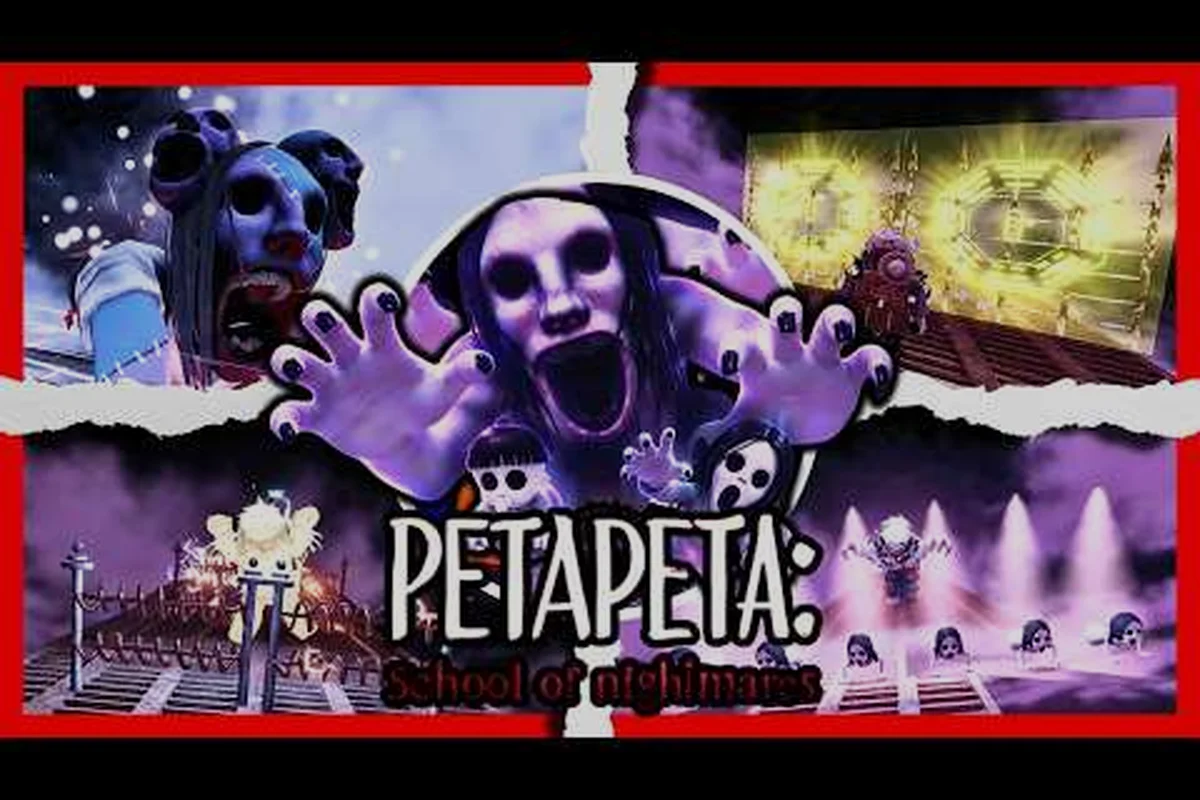
PETAPETA School of Nightmares lore moves the series out of the haunted house and into a school where the rules themselves become the monster. The sequel keeps the touch rule intact while swapping the setting, and understanding why matters because the new locations carry the story forward.
The original game taught you to fear contact. The follow-up asks what happens when the building you are trapped in was designed to teach you something. That shift is the whole reason the sequel's lore is worth digging into, and it is where the Cursed Mine Island material starts to connect.
What PETAPETA School of Nightmares Changes in the Series
The sequel is the second entry in the franchise, and the official Roblox game page confirms it continues the story that began with the first PETAPETA while evolving the same touch rule and hiding mechanics. Same studio, same core fear, new architecture. That continuity is what makes the School of Nightmares lore feel like a chapter rather than a spinoff.
What actually changes is the shape of the space. A house funnels you through corridors and bedrooms; a school gives you classrooms, hallways, and a bell schedule that implies someone is still running the place. The monster does not need to be faster when the map itself keeps rearranging your escape routes.
-
Touch rule preserved — contact still kills, so the sequel's difficulty comes from navigation, not new combat
-
Hiding mechanics evolved — lockers, desks, and blind corners replace wardrobes and beds
-
Setting as antagonist — the school's layout communicates intent the creature never states aloud
-
Six levels — the sequel's structure is tighter than the original's ten-stage run
The table below compares how the two entries handle the same core systems — core threat, level count, primary setting, hiding objects, narrative delivery, and difficulty curve — which is the cleanest way to see what the sequel actually inherited. Reading it row by row, the touch rule and narrative-delivery columns stay functionally identical, while level count and hiding objects are where the School of Nightmares diverges most sharply. That split tells you the sequel kept the original's death condition and storytelling vocabulary but rebuilt the spatial and pacing layer around them, so any expectation carried over from the ten-stage house run needs re-checking against the six-level school layout.
| System | Original PETAPETA | School of Nightmares |
|---|---|---|
| Core threat | Touch kills instantly | Touch kills instantly |
| Level count | Ten stages | Six levels |
| Primary setting | Residential house | School building |
| Hiding objects | Wardrobes, beds, curtains | Lockers, desks, storage rooms |
| Narrative delivery | Notes, posters, badges | Classroom materials, announcements |
| Difficulty curve | Gradual across ten stages | Compressed across six |
That compression is deliberate. Fewer levels means each one carries more story weight, and the School of Nightmares lore leans on environmental detail instead of pacing you through a long tutorial arc. If you want the foundation underneath all of this, the PETAPETA story and lore breakdown covers the original timeline in detail.
What Each of the Six SoN Stages Represents
Six levels sounds short until you realize each one is a thesis statement. Community walkthroughs, including a full Level 6 playthrough and ending video posted in late October 2026, show a run that escalates from orientation-style exploration to a finale that recontextualizes the building. The structure reads like a school year compressed into a single night.
Orientation: Levels 1 and 2
The opening pair teaches the touch rule again without admitting it is a tutorial. Classrooms are open, hallways are wide, and the monster stays distant enough that you learn its audio cue before you learn its speed. Pay attention to the announcements here, because the School of Nightmares lore plants its first clues in background noise rather than in readable text.
Midterm: Levels 3 and 4
This is where the building stops being helpful. Doors that opened before now stay shut, and the hiding spots you memorized stop being safe because the creature starts checking them. The mid-game spike mirrors what the original did around its fifth stage, but the sequel compresses the ramp so you feel the shift within a single session.
Finals: Levels 5 and 6
The last two levels are where the Cursed Mine Island material begins to surface. Level 6 in particular is the payoff stage, and the ending sequence is the reason so many players replay it. The table below maps the six levels against their dominant mechanic and narrative function.
| Level | Dominant Mechanic | Narrative Function |
|---|---|---|
| Level 1 | Basic movement, first touch scare | Establishes the school as safe-looking |
| Level 2 | Hiding introduction | Teaches the creature's audio tells |
| Level 3 | Locked routes, forced detours | Reveals the building is controlled |
| Level 4 | Hiding spots become traps | Undermines your learned routine |
| Level 5 | Multi-room chases | Connects school to the mine thread |
| Level 6 | Finale route and ending choice | Resolves the School of Nightmares arc |
Notice that the creature never changes. What changes is your confidence in the map, which is a much cheaper and much crueler design choice. The monster lore and yokai origins article explains where that creature comes from, and the folklore context makes the finale read differently.
PETAPETA Cursed Mine Island Lore Explained
Cursed Mine Island is the piece of the sequel's worldbuilding that most players miss on a first run because it is delivered through fragments rather than exposition. The island sits underneath the school's story as a place the institution was built on top of, and the mining imagery ties directly into the franchise's broader curse logic.
Here is what the fragments suggest when assembled: the classroom materials that mention excavation and extraction are not decorative flavor text but the game's way of dating the haunting. The Cursed Mine Island fragments place the origin of the entity before the school's construction, meaning the PETAPETA 3 haunting is inherited rather than triggered — the institution simply built over a site that was already active. Read together with the mining imagery, the island functions as a source node rather than a visitable location, which is why the same curse rules that bind the creature in the school also apply there.
-
The school was built on something older — classroom materials reference excavation and extraction
-
The curse predates the building — the haunting is not caused by the school, it is inherited by it
-
The mine is a source, not a location — Cursed Mine Island functions as an origin point for the entity
-
The island connects to the wider universe — the same rules that bind the creature apply there
This is where the sequel's lore gets genuinely interesting. The original game implied a curse attached to a place. The sequel implies the curse is attached to a practice, and the school is just the most recent institution to inherit it. The supernatural and curse mechanics breakdown goes deeper into how those rules operate across the series.
Why the Mine Matters to the Ending
The finale only lands if you have been reading the environment. Players who sprint through levels 1 through 5 and treat the ending as a cutscene tend to walk away confused, while players who stopped to read classroom notes report the ending clicking immediately. That gap is the clearest sign that Cursed Mine Island is not decoration.
How PETAPETA 3 Fits Into the Story
PETAPETA 3 is the forward-looking thread, and the honest answer is that the sequel's ending leaves the door open without confirming anything. What the School of Nightmares lore establishes is a pattern: each entry takes the same touch rule and drops it into a new institution. A house, then a school, then whatever comes next.
The Cursed Mine Island material is the strongest signal about where PETAPETA 3 could go, because it is the only location referenced in the sequel that the player never fully visits. That is a classic setup. The table below lays out what is confirmed versus what remains speculation.
| Element | Status | Basis |
|---|---|---|
| School of Nightmares as second entry | Confirmed | Official game page |
| Six-level structure | Confirmed | Community walkthroughs |
| Cursed Mine Island as origin point | Strongly implied | In-game fragments |
| PETAPETA 3 as a mine-set entry | Unconfirmed | Fan inference |
| Returning creature | Confirmed | Gameplay footage |
Treat the third-entry speculation carefully. Community theories about the series timeline are worth reading, and the PETAPETA theories and endings collection tracks which fan readings have held up over time, but none of them are official until the studio says so.
Reading the Lore Without Missing It
The single most useful habit for following School of Nightmares lore is slowing down in rooms that feel empty. The sequel hides its story in the gaps between chases, and the game actively punishes players who treat every room as a corridor.
A practical approach that works across all six levels: treat each floor as a two-pass loop rather than a single sprint. On your first pass, prioritize survival and learn the patrol rhythm of the Nightmare creature; on the second, return specifically to harvest lore nodes you skipped. This matters because the Cursed Mine Island's creature AI escalates after level 4, adding new check points to hiding spots you previously trusted — so a hiding spot that worked on level 2 may be actively scanned on level 5. Budget roughly one extra run per floor for lore collection, and never attempt a board read while the creature is in an adjacent corridor, since the touch rule kills you mid-interaction.
-
Read every classroom board before moving on, because text does not respawn once you leave
-
Listen to announcements rather than tuning them out, since they carry the timeline
-
Check storage rooms even when they look like dead ends, because that is where mine references cluster
-
Revisit hiding spots after level 4 to confirm which ones the creature now checks
-
Watch the ending twice if the choice confuses you, because the second pass reframes the first
If you are still learning the fundamentals of the touch rule, the beginner guide covers the survival basics that make lore-hunting possible in the first place. You cannot read a classroom board while being chased.
Common Lore Misreadings
Two mistakes come up repeatedly in community discussion. The first is assuming the school is the source of the curse rather than its latest host. The second is treating Cursed Mine Island as a future level when the fragments position it as a past event. Both misreadings flatten the story into a simpler shape than the game actually presents.
Frequently Asked Questions
Is PETAPETA School of Nightmares a sequel or a remake?
It is a sequel. The official Roblox page describes it as the second entry in the franchise, continuing the story that started with the original PETAPETA while evolving the same touch rule and hiding mechanics. Same studio, new setting, continuous narrative thread rather than a retelling.
How many levels are in School of Nightmares?
Six levels. Community walkthroughs document a run that moves from orientation-style exploration through a mid-game difficulty spike and into a finale at Level 6. The shorter structure means each stage carries more narrative weight than the original's ten-stage progression.
What is PETAPETA Cursed Mine Island?
It is a location referenced through environmental fragments in the sequel rather than a fully playable area. The mine imagery suggests the curse predates the school and that the institution was built on top of something older. It functions as an origin point for the entity rather than a future map.
Will PETAPETA 3 be set on Cursed Mine Island?
Nothing official confirms this. The mine is the only major location referenced in the sequel that players never fully visit, which makes it a natural setup for a follow-up, but that reading is fan inference. Treat it as speculation until the studio announces anything.
Do I need to play the first game to understand the sequel's lore?
It helps considerably. The touch rule and hiding mechanics carry over directly, and the sequel assumes you already understand why contact is fatal. Playing the original first makes the School of Nightmares lore read as a continuation rather than a standalone mystery.
The sequel's story works because it never explains itself out loud. A school built on a mine, a creature that never changes, and an ending that only resolves if you were paying attention to the walls — that is the whole architecture of PETAPETA School of Nightmares lore, and it rewards the players who slow down long enough to read it.